🤫 The Silence of 10 Circular Road: Tejashwi Yadav's Retreat After Bihar’s Crushing Verdict
By [ADITYA ROY PODDAR], Award-Winning Political Correspondent PATNA | December 1, 2025
The sprawling 1.75-acre complex at 10 Circular Road, Patna, has long stood as a symbol of the Rashtriya Janata Dal’s (RJD) enduring power in Bihar. Home to party patriarch Lalu Prasad Yadav, his wife Rabri Devi, and their heir apparent, Tejashwi Yadav, the bungalow was perpetually a chaotic hub—a durbar teeming with hopeful party workers, local leaders, and reporters jostling for a glimpse or a soundbite.
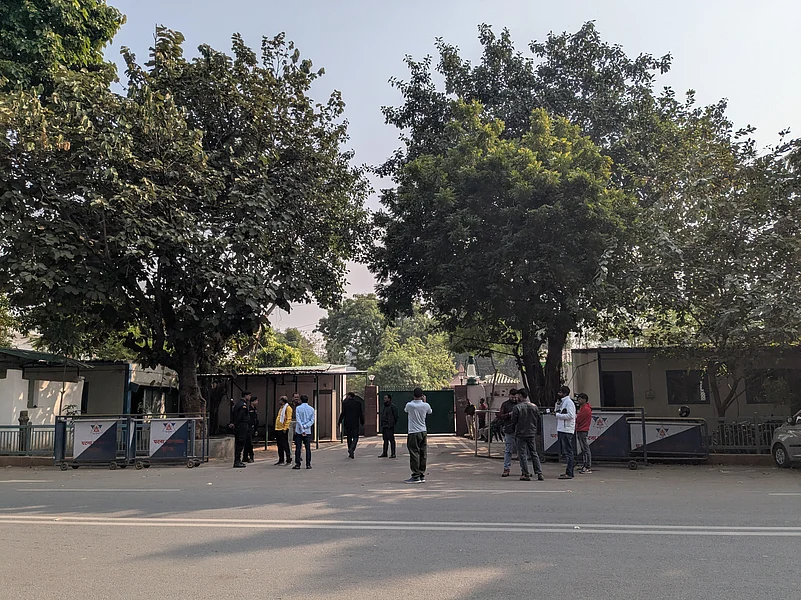
Today, that fortress of political activity is eerily silent.
Two weeks after the National Democratic Alliance (NDA) delivered a massive electoral drubbing to the RJD-led Mahagathbandhan in the 2025 Bihar Assembly elections, a profound stillness has settled over the compound. The deserted look reflects more than just defeat; it underscores a deepening crisis of morale and leadership within the state's largest opposition party.
Its young commander, Tejashwi Yadav—who, just a few weeks ago, commanded mammoth rallies and was the undisputed Chief Ministerial face—has vanished from the public eye.
The Stunning Retreat of the Star Campaigner
The official results, announced on November 14, 2025, were a catastrophic reversal for the RJD, which saw its seat tally plummet from its previous high to a mere 25. The Grand Alliance collectively secured just 35 seats, leaving the NDA with a landslide two-thirds majority.
In the immediate aftermath, Tejashwi Yadav executed a near-total political retreat. He skipped the new government’s swearing-in ceremony on November 20 and has declined all media engagement, a stark contrast to his father, Lalu Prasad Yadav, who reportedly maintains his daily routine of morning walks and public meetings.
The young leader’s silence has created a vacuum that is actively sapping the spirit of the party’s grassroots base.
"We are so dejected that it feels like someone has died in our family," one digital wing worker lamented, echoing the anguish of loyalists who feel abandoned. A longtime worker from the Musahar community pleaded, "He should not disappear like this. We want him to engage in worker-to-worker dialogue... and return to the ground with strength."
This communication breakdown is not merely a matter of style; it is seen by many within the RJD as a critical failure of leadership at a time when the rank-and-file desperately needs direction.
Unpacking the Catastrophe: The Electoral Arithmetic that Failed
While the seat count delivered a humiliating defeat, a deeper dive into the numbers reveals a complex political puzzle—and a potential lifeline.
The RJD technically emerged as the single-largest party in Bihar in terms of voter allegiance, securing a 23% vote share. This figure is only marginally lower than its previous performance and higher than the individual tallies of the Bharatiya Janata Party (BJP) and the Janata Dal (United) (JD(U)).
How can a party with the largest vote share lose so badly?
Political analysts point to a classic failure of vote conversion under India’s 'First-Past-The-Post' system. Simply put, RJD’s votes were spread too thinly across constituencies, resulting in a large number of second-place finishes.
Political commentator Prasanna Kumar Chaudhary summarizes the unyielding political law of Bihar: "If two major parties come together, they will win, and the third will be decimated." In this election, the NDA's alliance strength, efficient vote distribution, and the JD(U)'s sudden electoral comeback proved fatal to the fragmented opposition.
Adding to the complexity, the RJD's traditional political pillars fractured:
-
EBCs Did Not Consolidate: Despite making an EBC leader the state president and fielding 23 EBC candidates, the crucial Extremely Backward Class vote overwhelmingly gravitated toward the JD(U) and the NDA. Only two RJD EBC candidates won.
-
The Yadav Shift: Even the core Muslim-Yadav (M-Y) equation showed signs of cracking. Of the 51 Yadav candidates fielded by the RJD, only seven were victorious, while the NDA, which fielded far fewer, won 15. The Muslim vote, meanwhile, showed an increased polarization towards the AIMIM in certain pockets.
Internal Strife and the Question of Leadership
The election fallout has intensified pre-existing internal frictions. Sources close to the party's inner circle have cited a litany of campaign failures
-
Ticket Distribution: Allegations of ignoring loyal, grassroots leaders in favour of well-funded turncoats.
-
Alliance Coordination: Poor synergy and communication with Mahagathbandhan partners like the Congress.
-
Adviser Influence: Murmurs of discontent over the unchecked power of Tejashwi Yadav’s core team, which reportedly sidelined veteran leaders and ground intelligence.
Furthermore, the decision to unilaterally project Tejashwi Yadav as the Chief Ministerial candidate appears to have been a double-edged sword. While it energized a young electorate, it also personalized the contest, turning it into a direct "Nitish versus Tejashwi" battle, in which voters ultimately opted for the seasoned incumbent.
The Path to the Frontline: Comeback Strategy Begins in the Assembly
Despite the silence and the internal turmoil, the RJD and the broader Mahagathbandhan have not been static. The most significant development came this past weekend:
On Saturday, November 29, 2025, the Mahagathbandhan legislators unanimously elected Tejashwi Yadav as their coalition leader in the state legislature.
This decision, taken just two days before the start of the new Assembly session on December 1, is a decisive move to solidify his position, project unity, and mandate his leadership of the opposition inside the House.
Now, as the newly minted Leader of the Opposition, Tejashwi Yadav faces a triple-pronged task:
-
Organizational Cleanup: The RJD has initiated a comprehensive, division-wise review meeting (scheduled to run until December 9) to conduct a granular post-mortem of the defeat. The focus is on identifying flaws in internal coordination and ticket selection.
-
The Legislative Battle: The Assembly floor will now serve as his first major public platform since the defeat. The Opposition is gearing up for a combative session, determined to hold the NDA government accountable on issues ranging from unemployment to alleged electoral irregularities.
-
The Statewide Tour: According to party insiders, Tejashwi Yadav is preparing to "hit the ground" with a statewide tour in the coming weeks. This tour is intended to reconnect directly with workers, gather unfiltered feedback, and rebuild the grassroots organization from the district level up.
Conclusion: The Long Road to Revival
The contrast between the silent, guarded Circular Road bungalow and the bustling, adversarial environment of the Legislative Assembly session opening today encapsulates Tejashwi Yadav’s immediate challenge.
The retreat was a necessary political processing period, but the time for solitude is over. His highest vote share proves his underlying popularity; his greatest loss proves his structural weakness.
For the RJD to avoid repeating its 2010 decimation, the scion of the Yadav dynasty must transform his electoral popularity into political efficiency. His new role as the Leader of the Opposition demands a visible, aggressive, and communicative presence. Whether Tejashwi Yadav can shed his post-defeat shell, mend the fractures within his family and party, and leverage his technical popularity into a successful opposition movement will define not just his political future, but the very dynamics of Bihar politics for the next five years.
The Lantern, the party's symbol, may be dim, but the leader must now prove that the flame has not been extinguished